
Embedded controls and firmware
We design firmware around the hardware it has to control, then document the interfaces, states and tests needed to move the prototype forward.
→Electronic systems, engineered at the level the problem requires.
Herder Elektronische Systemen develops, integrates, recovers and validates electronic systems across embedded firmware, motor control, power electronics, instrumentation and test.
The work may be as focused as selecting a cost-effective power supply, configuring an Arduino-class controller, correcting a communications interface or establishing a repeatable test. More complex engagements may involve custom flyback magnetics, mixed-signal PCB development, deterministic TI C2000 motor control, dual-core STM32 architecture, CAN-connected real-time testing or recovery of an incomplete hardware-software platform.
The difficult part is often the space between disciplines. We bring hardware, firmware and control together, then test the system as a whole.
We design firmware around the hardware it has to control, then document the interfaces, states and tests needed to move the prototype forward.
→We help shape converter prototypes, bring them up on the bench and use measurements to guide the next design decision.
→We build repeatable tests that connect instruments, data and analysis, so the results are easier to trust and review.
→When a project has inherited code or unclear behavior, we trace the problem across hardware, firmware and communications and leave a documented path forward.
→Herder Elektronische Systemen takes ownership across the embedded development chain: processor selection, firmware architecture, hardware interfaces, test software, measured validation and technical handoff.
Custom STM32H747 firmware architecture using OpenAMP and shared-memory interprocessor communication between Cortex-M7 and Cortex-M4, with explicit division between real-time hardware tasks, communications and supporting software.
Development from low-level C firmware, interrupts and peripheral timing through Python tooling, telemetry, logging, plots and repeatable operating documentation.
Version-controlled ownership and maintenance of TI C2000 motor-control, HIL and dynamometer test systems, including CAN communications, Speedgoat real-time integration, command and telemetry structure, safety timeouts and measured speed, torque, power and efficiency workflows.
Embedded products supported beyond firmware alone, with diagnostic tools, configuration software, automated tests and user-facing applications developed around the final hardware.
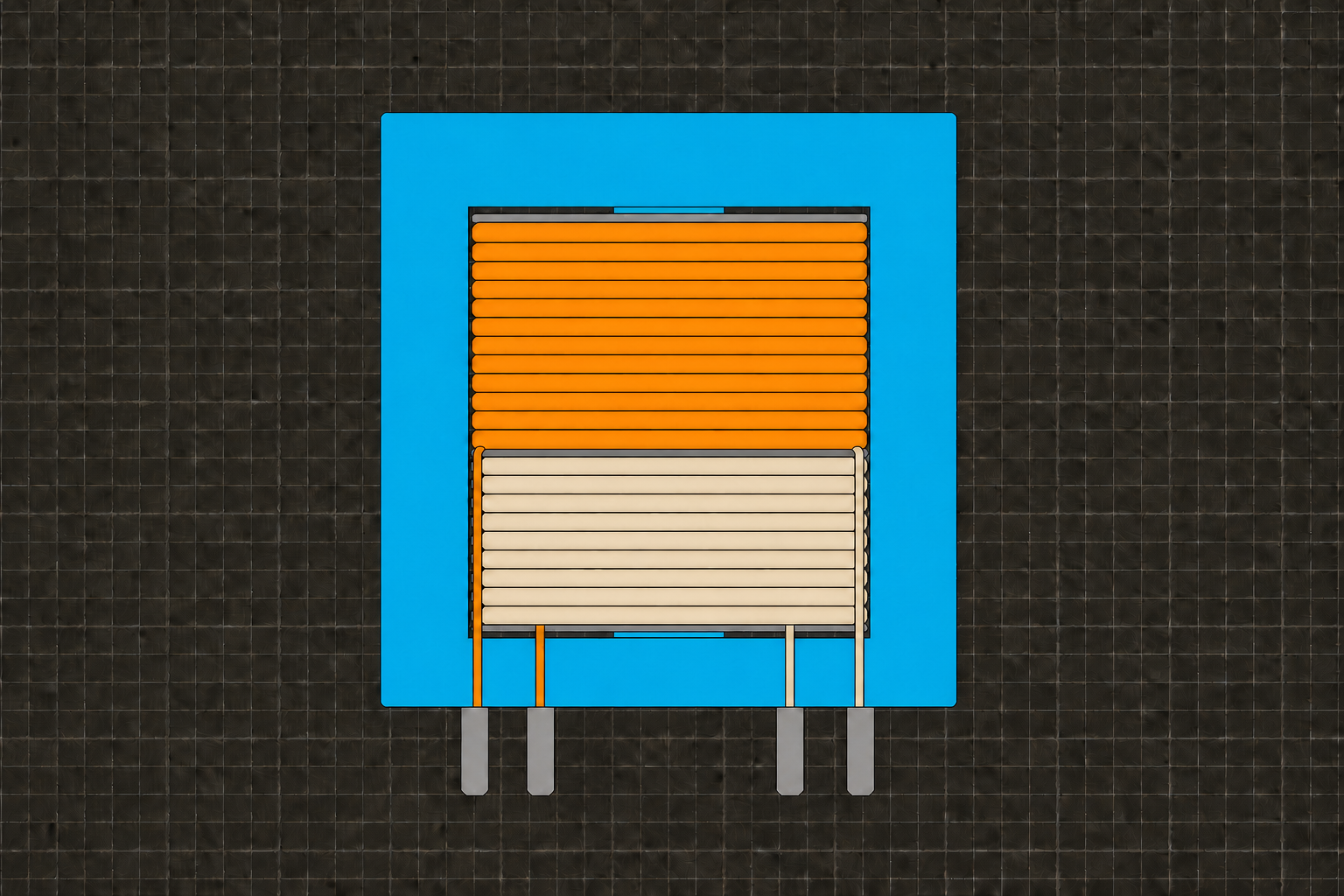
CUSTOM MAGNETICS / SMPS DEVELOPMENT
Transformer definition, winding construction, 3D modeling and bench evaluation for switch-mode power-supply development.
Explore custom magnetics →Featured tool
Use topology-specific calculators to check flyback, boost, buck, LLC and PSFB boundaries from a prospective operating point.
Open SMPS feasibility tools →The calculator sits closer to the magnetics section so the homepage shows the broader engineering context first, with the specific tool following the overview.
We use requirements, prototypes and measurements to expose the important tradeoffs before they become expensive failures.
Bring us your challenge →We start with the system, its users and its constraints.
We test the assumptions that matter, integrate the pieces and resolve the problems that block progress.
You leave with a working system, the evidence behind it and documentation another engineer can use.
These projects show how the work looks in practice: working hardware, firmware, controls and validation. They are public technical projects, not completed client contracts.
A complete robotics-control platform integrating inertial sensing, wireless operator input, encoder feedback, motor drive, servo control and self-balancing PID behavior.
An offline flyback prototype documented from transformer winding and component selection through waveform capture and bench validation.
A hardware-backed F28069M demonstrator for command handling, explicit state control, PWM output, setpoint validation and fault response.
Transformer definition, winding construction, 3D modeling and measured bench evaluation for SMPS development.
MICHIGAN TECHNOLOGICAL UNIVERSITY RESEARCH AND GRADUATE LABORATORY PLATFORM
Developed in Herder Elektronische Systemen’s lab using company-owned equipment, within Michigan Technological University’s electrified-propulsion lab context, and prepared for integration into ME 5990 Electric Propulsion Systems graduate instruction and research in motor control, real-time systems, CAN communications, and drivetrain validation.
Jonathan led the integration and technical recovery of the dual-motor control platform, including embedded-control development, QEP feedback, SCI-to-CAN migration, Speedgoat real-time integration, and repeatable torque, speed, power, and efficiency validation workflows.
The repository includes architecture documentation, hardware integration notes, MATLAB/Python processing, efficiency maps and measured speed, torque and power data.
This work was completed in Herder Elektronische Systemen’s lab using company-owned equipment. It is presented as public academic and research work associated with Michigan Technological University, not as a privately owned Herder Elektronische Systemen product or completed client engagement.
From requirements to clear interfaces
Design support for prototypes
Communication that fits the system
Results tied to test conditions
The process keeps risk visible and gives each phase a clear next step.
Herder Elektronische Systemen is an independent engineering practice led by Jonathan, focused on embedded systems, controls, electronics, test development and system integration.
The practice is intentionally small and hands-on, rather than a large staff or production organization.
Start a technical discussion
Based in Michigan, United States, and serving U.S. laboratories, manufacturers, technical teams and small industrial firms.
Send a short brief. We’ll ask the right questions, clarify the next step and help define what the work needs.
Project details are handled confidentially. Please do not send sensitive files in the initial email; secure file exchange can be arranged afterward. Public portfolio material is published only when authorized.
Start a technical discussion →Or write directly: [email protected]